

The Melody Bar: New Brunswick's Underground Heart
How a tiny French Street bar became one of New Jersey's most important music and cultural landmarks,
and how it was quietly erased.
The Name on the Door
There is a particular kind of New Jersey story that never makes it into the glossy retrospectives about the Stone Pony or the Meadowlands. It lives instead in the memory of people who drove into cities that most of their suburban neighbors had been warned to avoid, cities like New Brunswick in the early 1980s, when its downtown was near-empty after dark, when parking your car was considered a gamble and walking the streets alone after midnight felt like a calculated risk. Into that silence, two city residents named Cal Levine and Steve Flaks walked into a neighborhood bar on French Street in March 1981 and decided to make something happen.
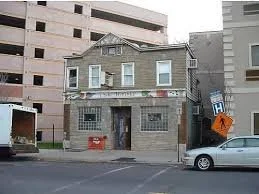
The bar they took over had been a fixture of the local Hungarian-American community for decades — a modest, unpretentious place that had served the midcentury immigrant neighborhood that once anchored this part of New Brunswick. The Hungarian family who owned it before had a daughter named Melody. Levine and Flaks kept the name. It fit.
What they built over the next two decades was something that defied easy categorization. The Melody Bar was a dance club and a live music venue, a gallery space and a community clubhouse, a DJ booth where the future of music television was being quietly rehearsed, and a refuge for artists, musicians, poets, and anyone who felt like they didn't quite fit anywhere else. It was, by most accounts, one of the greatest small venues New Jersey ever produced — and when it closed without warning in 2001, and was demolished three years later, it left a hole in the culture of central Jersey that has never fully been filled.
The Sound of the Place
To understand the Melody Bar, you have to understand what it meant to hear The Cure or Depeche Mode or The Smiths on a dance floor in central New Jersey in 1982. These were not bands getting substantial commercial radio play in the market. The mainstream was elsewhere, in the classic rock FM universe, in the synth-pop crossover hits, in the arena rock that filled stadiums up the turnpike. What was happening at the Melody was an act of curation, a deliberate argument that this music, goth, post-punk, new wave, alternative rock, early hip-hop, house, deserved a room and a dance floor and a crowd willing to sweat to it.
The venue had two levels. Downstairs was the original bar, small, intimate, thumping with bass from the DJ booth. Upstairs, a room called "Room at the Top" was added in 1985: a cozy lounge space with café tables, backlit glass block, and a modest stage riser that hosted jazz nights, acoustic sets, and more intimate performances. The walls throughout were treated as gallery space, exhibiting work from local visual artists and students from Rutgers' Mason Gross School of the Arts. You could come in on a given night and find paintings you'd never expect in a bar, hanging next to a set list, next to a band poster, next to a snapshot of last weekend's crowd.
The Melody was porous in the best way, the boundaries between performer and audience, between visual art and music, between DJ culture and live performance were deliberately blurred. A free jukebox stocked with 80 45-rpm records and constantly updated with listener requests sat in the bar, functioning, as co-owner Cal Levine put it, as "an archive to be added to." It was a philosophy that ran through the whole operation: the Melody was always accumulating culture, always adding to what it was.
Notable Artists and the Scene Around Them
The Melody attracted an eclectic and sometimes extraordinary cast of visitors. Miles Hunt of the British indie band The Wonder Stuff was a regular presence; Mick Jones of The Clash passed through; Beat Generation poet Gregory Corso — one of the founding voices of the literary movement that had given rise to so much of the countercultural spirit the Melody embodied — was known to show up. It was that kind of place: one where the lines between New Jersey and London, between a rock stage and a poetry reading, felt genuinely permeable.
The local and regional scene that formed around the bar was equally remarkable. A group of New Brunswick musicians who called themselves the "Slaves of New Brunswick", a tongue-in-cheek homage to their devotion to the city, used the Melody as their home base. Among them were guitarist and singer Glen Burtnick, who would go on to wider national recognition, and bassist Tony Shanahan, a key figure in New Brunswick's rock scene whose band The Boogles helped define the sound of the city's early-80s musical moment. Their weekly jam sessions at the Melody were legendary: loose, collaborative affairs that could veer from tight original rock to long improvisational runs depending on who showed up.
The bar also served as a shooting location for "Ill Will," an independent film made in the area during the mid-1980s, with Melody Bar patrons appearing as extras and local bands, including Jigs & the Pigs, contributing to the soundtrack. It was a sign of how deeply embedded the club had become in the creative life of the region: it wasn't just a place where culture was consumed, but one where it was actively made.
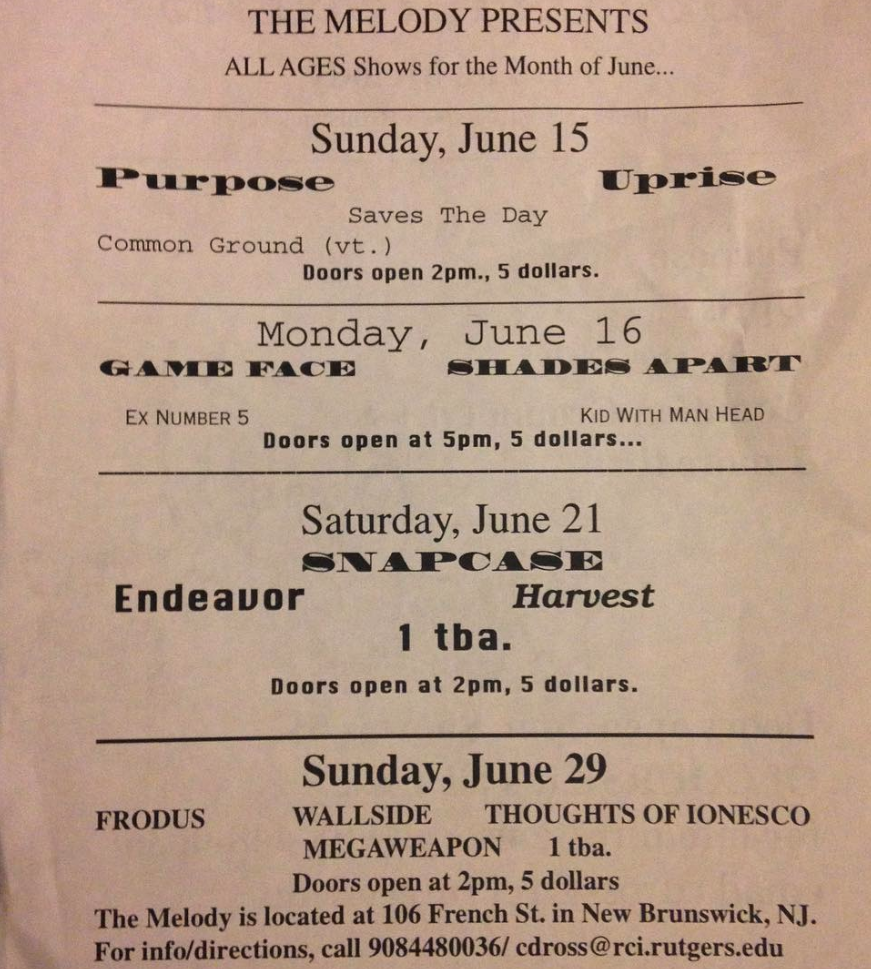
By the 1990s, the venue had evolved. Post-hardcore and emo bands, including Thursday, who would go on to become one of the most important acts to emerge from the New Jersey scene, performed there. The rock-and-roll energy of the 80s crowd had given way to something harder-edged and more emotionally direct, but the Melody's essential character, its embrace of artists who existed slightly outside the mainstream, its sense of being a home for people who needed one, remained intact.
Matt Pinfield and the DJ as Tastemaker
No single figure is more associated with the Melody Bar's legacy than Matt Pinfield. He came to the club as a DJ in the early 1980s, having already been involved in Rutgers University's radio station WRSU where he'd founded the "Overnight Sensations" program dedicated to local music. At the Melody, he became something more than just a guy playing records: he was a genuine tastemaker, an evangelist for the alternative music that was coursing through the underground at the time, and his Saturday night sets drew packed, sweating crowds to that small French Street dance floor.
Pinfield's trajectory from the Melody Bar to national celebrity is one of the more remarkable career arcs in New Jersey music history. After his years at the club, he moved to commercial radio at WHTG 106.3, becoming one of the most influential alternative music voices in the Northeast. From there, he landed at MTV, where he became the host of "120 Minutes," the late-night alternative music showcase that introduced millions of viewers to the same artists he'd been playing on that tiny New Brunswick dance floor years earlier. In 1997, he actually brought MTV cameras back to the Melody to tape an episode, a full-circle moment that drew enormous crowds and turned the bar, briefly, into a national news story.
Pinfield's story matters to the Melody's legacy because it illustrates something important about what the club actually was: not just a local bar, but a genuine incubator of taste and talent. The same sensibility that filled that dance floor on Saturday nights in 1984 was, more or less, the sensibility that shaped American alternative music television a decade later. New Jersey, and New Brunswick in particular, was the lab. The Melody Bar was the petri dish.
The Closing and the Wrecking Ball
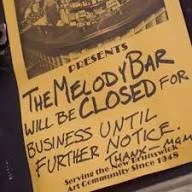
The Melody Bar closed in 2001 without advance notice — no farewell show, no announcement, no formal goodbye. The closure was attributed in part to the economic pressure of New Brunswick's ongoing redevelopment, which had been transforming the city's relationship to its own culture for years. Robert Wood Johnson University Hospital had been purchasing surrounding land and had its eye on the French Street property for some time. There were no legal mechanisms to protect a music venue from that kind of institutional appetite, and no political will to create them.
In early January 2004, the building was demolished, quietly, abruptly, without ceremony. The stated purpose was to expand the adjacent science high school. The timing reportedly caught even the schools superintendent off guard. For those who had spent formative years in that building, who had danced on that floor and stood in line on French Street and discovered music that would define them for the rest of their lives, the news arrived like a small personal erasure.
The broader pattern is worth noting. New Brunswick has a long history of demolishing its own cultural landmarks: the Strand Theatre on the corner of George and Albany streets, gone in 1965; the Bijou Theatre on Albany, also 1965; the RKO Theatre on Albany, demolished in 1972. The Melody joined a list of spaces the city chose not to preserve, not to commemorate, not to leverage as cultural heritage the way that Asbury Park has leveraged its music history or Hoboken has leveraged its. Tony Shanahan, the bassist who'd helped define the sound of the New Brunswick scene, put it plainly: "To me, that's the cultural center of the city, and it's been that way for many years." He was talking about the Court Tavern, but he could have been talking about the Melody.
What It Left Behind
What the Melody Bar left behind is harder to measure than a building or a setlist. It left behind a generation of New Jersey musicians and artists who had a place, for twenty years, to exist on their own terms. It left behind Matt Pinfield, whose career is inseparable from the education he got behind that DJ booth. It left behind the Thursday shows, the jazz nights upstairs, the art on the walls, the free jukebox with its constantly evolving archive, the benefit concerts (including a 1987 fundraiser for the Hyacinth Foundation AIDS Project that raised $650 at a moment when New Jersey had the fifth-highest rate of reported AIDS cases in the country).
It also left behind a model for what a music venue can be when it takes its community seriously, when it treats the walls as gallery space, the DJ booth as a classroom, the dance floor as a democracy of taste, and the bar itself as a place where a Beat poet and a post-hardcore band and a future MTV host can all feel equally at home. Those are not small things to leave behind.
The building is gone. In its place stands an expansion of a science high school — useful, no doubt, and serving real educational purposes. But the city that demolished the Melody Bar, the Roxy, the Court Tavern, and the old theaters of Albany Street is also a city that made its own cultural history harder to find, harder to celebrate, and harder to pass on. The Melody Bar deserved better than that. So did the city it helped build.
Lost New Jersey is a blog series exploring the forgotten and demolished music venues of the Garden State. This post is the first installment.